
Botswana Qualifications Authority (BQA) today, 08 October 2026, engaged Marketing, Communications, Public Relations (PR) and Student Recruitment personnel from Education and Training Providers (ETPs) to strengthen collaboration and promote accurate, responsible and consistent communication on BQA’s mandate and key regulatory matters.
Held virtually through Microsoft Teams, the consultative workshop formed part of BQA’s ongoing stakeholder engagement and public education efforts. It brought together practitioners who play an important role in providing information to prospective and enrolled learners, the public and other stakeholders.
The session highlighted the importance of communication as part of quality assurance, particularly in ensuring that information on learning programmes, qualifications, accreditation status and regulatory matters is accurate and verifiable.
Keeping Learners at the Centre of Communication
Opening the workshop, BQA Acting Chief Executive Officer, Dr Samuel Mosweu, emphasised that information shared through advertisements, institutional publications, social media and recruitment conversations can influence decisions with lasting consequences for learners and their families.
He underscored the shared responsibility to provide accurate, clear and reliable information, recognising that behind every application is a learner with aspirations and, often, a family making significant financial sacrifices.
Dr Mosweu highlighted that quality assurance extends beyond regulators and academic departments. Marketing, Communications, PR and Student Recruitment teams contribute directly through the claims they publish and the guidance they
provide. Their messages should accurately reflect the registration and accreditation status of institutions and their learning programmes.
He encouraged participants to coordinate closely with relevant offices within their institutions, verify information whenever there is uncertainty, and maintain dialogue with BQA.
Strengthening Communication Capacity
The Manager, Communications and Public Relations, Ms Letlhogonolo Paulo, outlined the workshop’s objectives. The engagement focused on strengthening the capacity of ETP Marketing, Communications and PR Officers to understand BQA’s mandate and regulatory requirements, promote compliant marketing and public communication, minimise misleading information and reputational risks, and strengthen collaboration between ETPs and BQA.
Ultimately, the engagement sought to contribute to greater public and learner confidence in Botswana’s education and training sector.
Ms Paulo highlighted the role of communication professionals as key information gatekeepers. Prospective learners often rely on institutional websites, prospectuses, advertisements, social media, open days and direct recruitment engagements when deciding where and what to study. Communication teams were therefore encouraged to work closely with academic, quality assurance and management structures to ensure that public messages are supported by verified information.
Understanding BQA’s Mandate, the NCQF and the Transition from Legacy Programmes
Acting Director, Quality Assurance, Ms Gofetamang Phirinyane, presented BQA’s mandate and services, including its role in maintaining the National Credit and Qualifications Framework (NCQF) and coordinating quality assurance across Botswana’s education and training system.
She explained the NCQF as a ten-level, credit-based and outcomes-based framework that supports the understanding and comparison of qualifications across General
Education, Technical and Vocational Education and Training, and Higher Education. The presentation also addressed services such as learning programme accreditation, evaluation of qualifications and institutional audits.
Participants were taken through the transition from legacy programmes to NCQF-aligned programmes, including differences in qualification levels, credit arrangements and quality assurance requirements. The session provided context to help communication and recruitment teams explain programme and qualification information accurately to learners and other stakeholders.
Key Issues Discussed
Key areas addressed included accurate accreditation communication, responsible marketing and advertising, misleading claims, learner protection, and digital and social media communication. Participants were encouraged to ensure that all information shared with the public is clear, accurate, current and consistent with the institution’s verified status.
The workshop emphasised the need to distinguish institutional registration and accreditation from the accreditation status of individual learning programmes. Communication teams were encouraged to verify both before publishing advertisements or advising prospective learners.
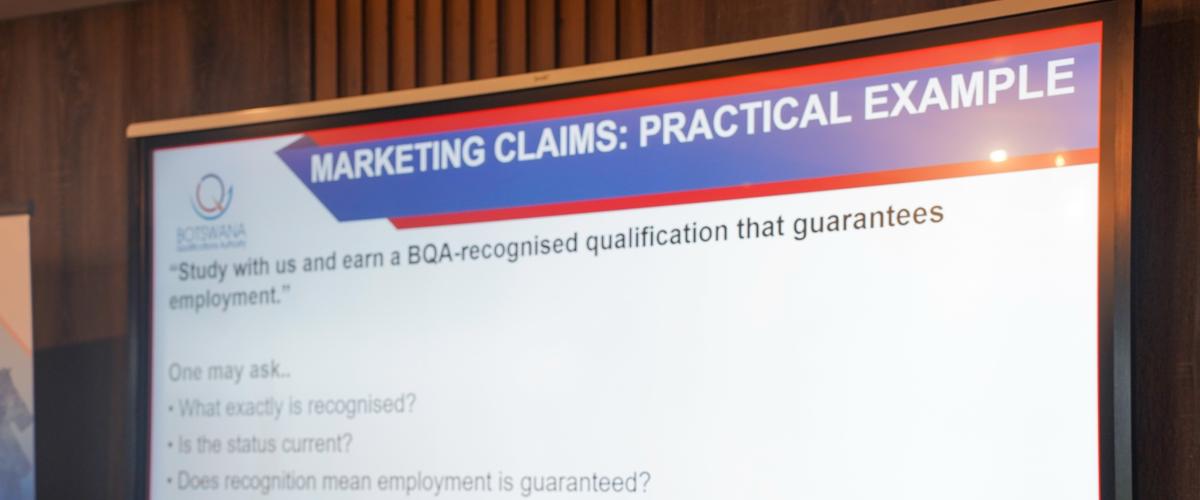
Participants were also reminded to provide clear information on programme titles, entry requirements, duration, delivery mode, fees, qualifications awarded and applicable conditions. Claims about employment guarantees, progression opportunities, professional recognition and international recognition should be supported by evidence and presented with the necessary context.
The same standards apply across websites, social media, online advertisements, videos and other communication channels. Institutions were encouraged to update outdated information promptly and establish internal review processes for materials containing regulatory claims.